
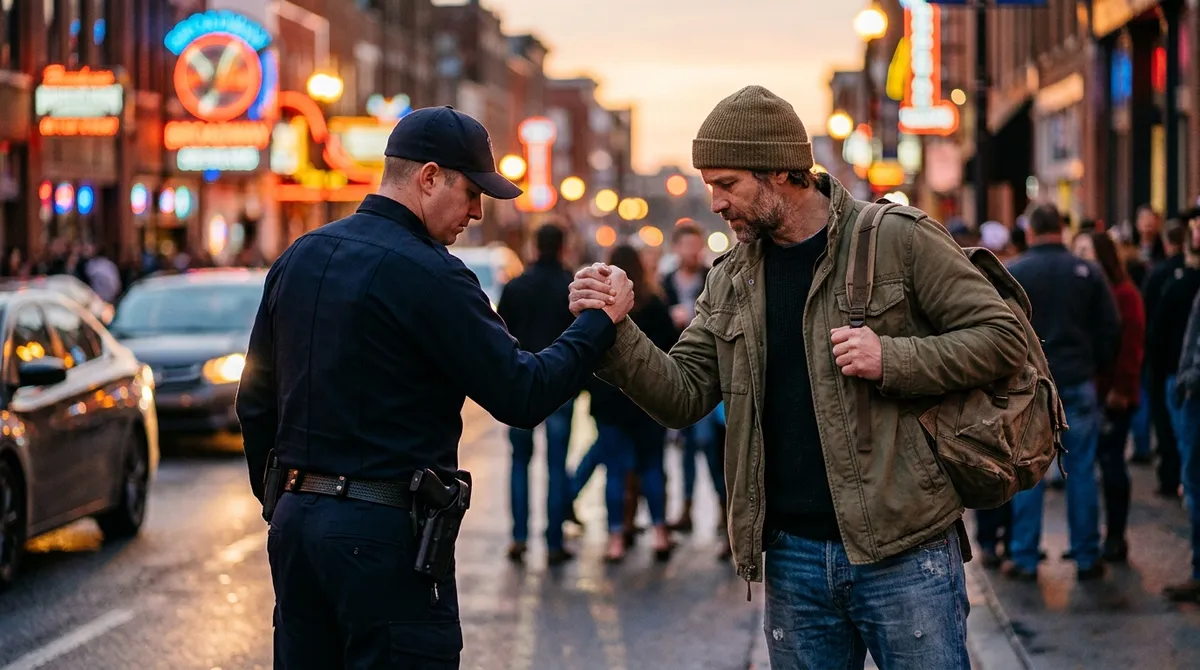
A British police officer traveled to Nashville expecting music, food, and a memorable holiday. Instead, the off-duty visitor became part of a real-life rescue after stepping in to help a Metro Nashville police officer facing danger during an arrest.
A vacation in Nashville turned into an emergency response
Nashville draws millions of travelers each year with its live music, Southern hospitality, and bright downtown energy. For one British police officer, the visit offered more than sightseeing. While away from duty and far from home, he noticed a situation that demanded quick judgment.
The officer saw an American law enforcement colleague in a tense and risky encounter. A Metro Nashville officer was struggling to control a suspect, and the situation appeared to be escalating. Rather than step back as a tourist, the British officer moved toward the danger.
His response was immediate. He identified himself as a police officer, assessed the scene, and helped bring the suspect under control. That intervention gave the Nashville officer critical support at a moment when seconds mattered.
Why the British officer's quick action mattered
Police encounters can change rapidly. Even a routine stop or arrest can become unpredictable when a suspect resists, fights, or attempts to flee. In those moments, an officer working alone may face serious risk before backup arrives.
The British officer recognized the warning signs. His training helped him read the situation quickly. He understood the danger of hesitation, especially when another officer was already physically engaged.
By stepping in, he helped reduce the immediate threat. He did not wait for applause or official instruction. He acted because the need was clear, and because public safety work often depends on people who choose responsibility over comfort.
The intervention also protected bystanders. Busy areas in Nashville can fill quickly with pedestrians, tourists, and drivers. A prolonged struggle can place nearby people at risk, especially if the suspect breaks free or the fight moves into traffic.
Off duty, overseas, but still ready to serve
One of the most striking parts of the story is that the British officer was not working. He was on holiday. He had no local assignment, no duty shift, and no expectation of becoming involved in a policing incident in the United States.
Yet many emergency workers carry their training everywhere. Police officers, firefighters, paramedics, and military personnel often notice risks that others miss. Their experience can make them react faster when a crisis appears in everyday life.
That instinct was on display in Nashville. The British officer did not have his familiar uniform, equipment, or colleagues around him. He also had to act in a different country, under different procedures, in an unfamiliar city.
Even so, the core principles remained the same. Protect life. Support a colleague. Control the danger. Keep the public safe until more help arrives.
A reminder of the bond between officers worldwide
The rescue highlights a powerful connection between law enforcement professionals across borders. British policing and American policing differ in many ways, including equipment, legal systems, and daily operations. But the human responsibility at the heart of the job is shared.
Officers often describe that bond as immediate. They may wear different badges, speak with different accents, and serve different communities. Still, they understand the pressure of confronting danger when others are depending on them.
In Nashville, that common purpose bridged the Atlantic. The British officer saw someone in trouble and recognized a fellow public servant under strain. His response showed that professional duty does not always end at the border.
For the Metro Nashville officer, the support likely meant more than physical assistance. Knowing that someone capable had arrived can shift the entire momentum of a confrontation. It can restore control, steady decision-making, and prevent further harm.
How bystander courage can change an outcome
This story also speaks to a broader lesson about emergency response. Not every person can intervene physically in a dangerous situation. In fact, untrained involvement can sometimes create additional risk.
However, bystanders can still make a vital difference. They can call emergency services, give clear location details, move away from danger, record useful information, or alert others nearby. When trained responders are present, the key is to support their work without increasing chaos.
In this case, the person who stepped in had policing experience. That made his assistance especially valuable. He understood restraint, positioning, communication, and the importance of controlling hands during a physical struggle.
His actions offer a practical reminder. Courage is not recklessness. It is calm action guided by awareness, skill, and purpose.
Nashville's busy streets make quick backup essential
Downtown Nashville can be a challenging environment for emergency responders. Large crowds, nightlife, traffic, and noise can make even simple calls more complex. Officers must manage public safety while staying aware of their surroundings.
When a confrontation unfolds in such a setting, fast backup matters. A suspect may be difficult to restrain. Crowds may gather. People may misunderstand what is happening. Vehicles and pedestrians can turn a contained incident into a wider hazard.
The British officer's decision to assist helped limit that uncertainty. His presence added another trained set of hands until local support could take over. That kind of timely help can prevent injuries and shorten the duration of a dangerous encounter.
The human side of heroic policing
Stories like this often focus on the dramatic moment, but the human side deserves attention too. The British officer was likely expecting an ordinary trip. The Nashville officer was doing a difficult job in public view. Both found themselves connected by a sudden crisis.
Heroism often looks less like spectacle and more like decisive service. It can be a person walking toward trouble when others move away. It can be a calm voice during panic. It can be a steady grip that keeps a bad situation from becoming worse.
The Nashville rescue fits that pattern. There was no time for ceremony. There was only a problem, a threatened officer, and a trained visitor willing to help.
Public praise for a cross-border act of service
After the incident, the British officer's actions drew appreciation from people who saw the story as a bright example of international goodwill. It reminded many readers that public service is not limited to uniforms or official shifts.
Positive policing stories can resonate strongly because they reveal the best of the profession. They show responsibility, discipline, and care under pressure. They also encourage respect for the people who face unpredictable situations on behalf of their communities.
For Nashville, the episode became more than an unusual tourist story. It became a reminder that help can arrive from unexpected places, even from a visitor thousands of miles from his own beat.
A holiday defined by courage
The British police officer came to Tennessee as a traveler, but he left a mark as a rescuer. His decision to help a Metro Nashville officer showed courage, training, and a deep sense of duty.
In a city famous for unforgettable performances, this act of bravery became a different kind of standout moment. It was not staged, rehearsed, or announced. It happened because one off-duty officer saw danger and chose to act.
The result was a powerful reminder that service can cross oceans. Whether in Britain or Nashville, the commitment to protect others remains a shared language.