
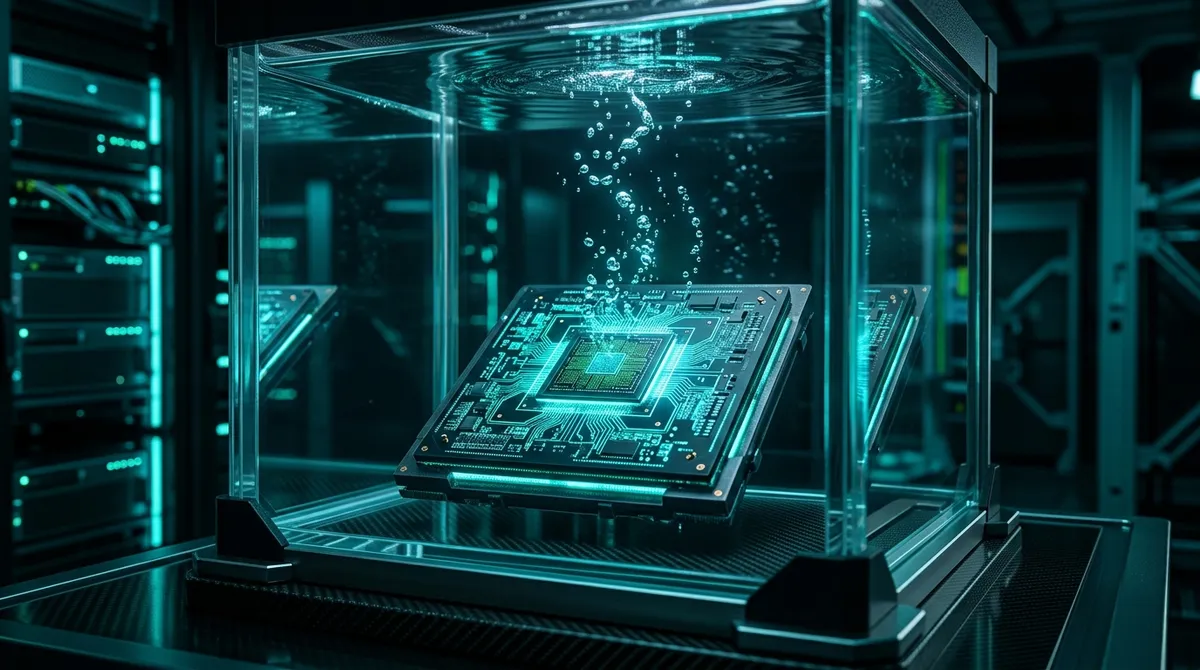
The AI Cooling Crisis
As artificial intelligence continues its explosive growth, a hidden infrastructure challenge is emerging that could determine the future of AI development. According to reports, data centers are projected to account for anywhere from 9% to 17% of total electricity usage in the U.S., with cooling systems consuming a major share of that electricity and water resources.
The problem is getting worse as AI chips run hotter and operators face increasing power constraints alongside mounting sustainability pressure. This has created what industry experts are calling a competitive infrastructure priority: finding more efficient ways to keep servers cool.
Nuclear Science Meets Data Centers
An MIT-born startup called Ferveret is addressing this challenge with an innovative approach that draws inspiration from an unexpected source: nuclear reactor cooling systems. The company has developed what it calls Adaptive Phase Cooling, a water-free liquid immersion system that applies nuclear reactor heat-transfer principles to cool AI data center servers.
The technology represents a significant departure from traditional cooling methods. Instead of relying on air conditioning or water-based systems, Ferveret's approach immerses servers directly in specialized liquid coolant, similar to how nuclear reactors manage extreme heat.
How Bubble Science Improves Efficiency
The key innovation lies in how the system manages heat transfer at the microscopic level. According to reports, Ferveret's Adaptive Phase Cooling produces smaller, faster-detaching bubbles compared to conventional liquid cooling systems. These improved bubble dynamics enhance heat transfer efficiency, which in turn boosts compute efficiency and reduces energy waste.
This bubble-based heat management approach allows data centers to squeeze more AI processing power from every watt of electricity consumed - a critical factor as operators struggle with power limitations and rising energy costs.
Addressing Water Scarcity Concerns
One of the most significant advantages of this nuclear-inspired approach is its water-free operation. Traditional data center cooling systems consume enormous amounts of water, creating sustainability challenges, especially in drought-prone regions where many large data centers are located.
By eliminating water usage entirely, Ferveret's system addresses a major environmental concern while potentially making data centers more compatible with renewable energy sources. This could prove crucial as tech companies face increasing pressure to meet sustainability commitments while scaling their AI infrastructure.
The Race for Next-Generation Cooling
The emergence of nuclear-inspired cooling technology highlights the broader race to solve AI's energy problem, which industry observers note is fundamentally a cooling problem. As AI models become more complex and require more computational power, the servers running them generate increasing amounts of heat that must be efficiently managed.
Reports suggest this has created a competitive landscape where different cooling approaches - from traditional air cooling to liquid cooling to next-generation immersion systems - are vying for dominance in the data center market.
Implications for AI Growth
The development of more efficient cooling systems could become what experts describe as a "hidden enabler" of AI growth. By reducing the energy overhead associated with keeping servers cool, technologies like Ferveret's could allow data centers to dedicate more of their available power to actual AI computation rather than infrastructure maintenance.
This efficiency gain becomes particularly important as the massive data center buildout driven by AI demand continues. According to reports, operators are increasingly viewing cooling efficiency as a competitive advantage that could determine which companies can scale their AI capabilities most effectively within existing power constraints.
Looking Ahead
As the AI industry grapples with sustainability challenges and energy limitations, innovations like nuclear-inspired cooling systems may prove essential for continued growth. The technology represents a convergence of nuclear engineering principles and data center infrastructure that could reshape how we think about powering the AI revolution.
While traditional cooling methods continue to dominate the market, the success of startups like Ferveret could signal a shift toward more exotic but efficient cooling technologies that draw inspiration from other high-heat industries like nuclear power.