
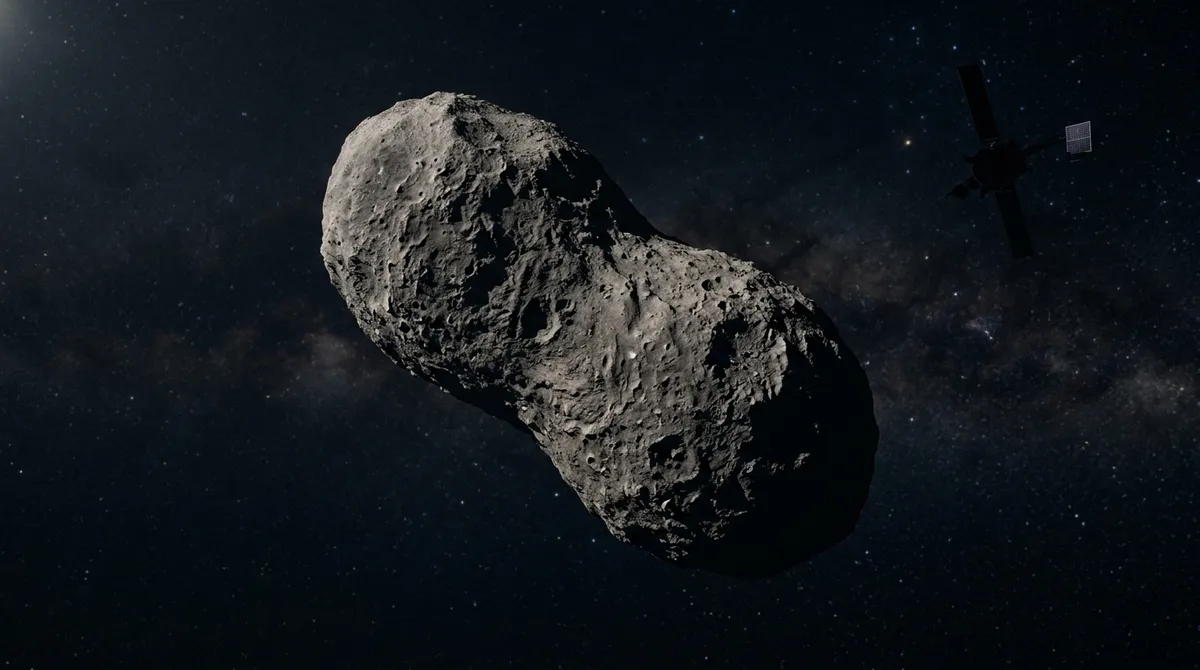
NASA's Lucy mission has achieved a groundbreaking milestone by capturing the first detailed images of the asteroid Dinkinesh, a discovery that reveals its unique peanut-like shape. These observations offer unprecedented insights into the physical characteristics and composition of this celestial object, contributing significantly to our understanding of asteroids.
The Journey of NASA's Lucy Mission
Launched with the goal of exploring Jupiter's Trojan asteroids, NASA's Lucy mission represents a pivotal moment in space exploration. This ambitious project aims to investigate these ancient bodies, which are believed to hold vital clues about the early solar system. By studying asteroids like Dinkinesh, scientists hope to unlock secrets about planetary formation and the origins of our cosmic neighborhood.
Discovering Dinkinesh: A Unique Asteroid
Dinkinesh stands out due to its distinctive shape, resembling a peanut. This peculiar form provides researchers with a rare opportunity to study how such asteroids might have formed and evolved over time. The insights gathered from Dinkinesh could help to refine existing models of asteroid formation and improve our understanding of the dynamic processes that shaped our solar system.
Technological Innovations in Space Exploration
The Lucy mission employs cutting-edge technology to achieve its objectives. Equipped with advanced imaging systems, the spacecraft can capture high-resolution images of asteroids, revealing details that were previously unseen. These technological advancements not only enhance our exploratory capabilities but also pave the way for future missions seeking to unravel the mysteries of space.
The Significance of Asteroid Studies
Asteroids are considered time capsules from the early solar system. Studying them can provide crucial information about the materials that existed during the solar system's infancy. By analyzing the composition and structure of asteroids like Dinkinesh, scientists can infer the processes that led to the formation of planets and other celestial bodies, offering valuable insights into our own planet's history.
Future Prospects and Potential Discoveries
The success of the Lucy mission opens new avenues for exploration and scientific discovery. As the mission continues, it will encounter additional asteroids, each with its own unique characteristics. These encounters promise to enrich our knowledge of the solar system and may lead to unexpected discoveries that challenge current scientific paradigms.
Implications for Planetary Defense
Understanding asteroids is not only important for scientific inquiry but also for planetary defense. By studying these objects, scientists can develop better strategies for predicting and mitigating potential asteroid impacts on Earth. The knowledge gained from missions like Lucy could be instrumental in protecting our planet from future threats.
Conclusion: A New Era in Space Exploration
The Lucy mission's successful imaging of Dinkinesh marks a significant achievement in the field of space exploration. By providing detailed observations of this unique asteroid, the mission enhances our understanding of the solar system and its formation. As we continue to explore the cosmos, each discovery brings us closer to unraveling the mysteries of our universe, inspiring future generations to reach for the stars.