
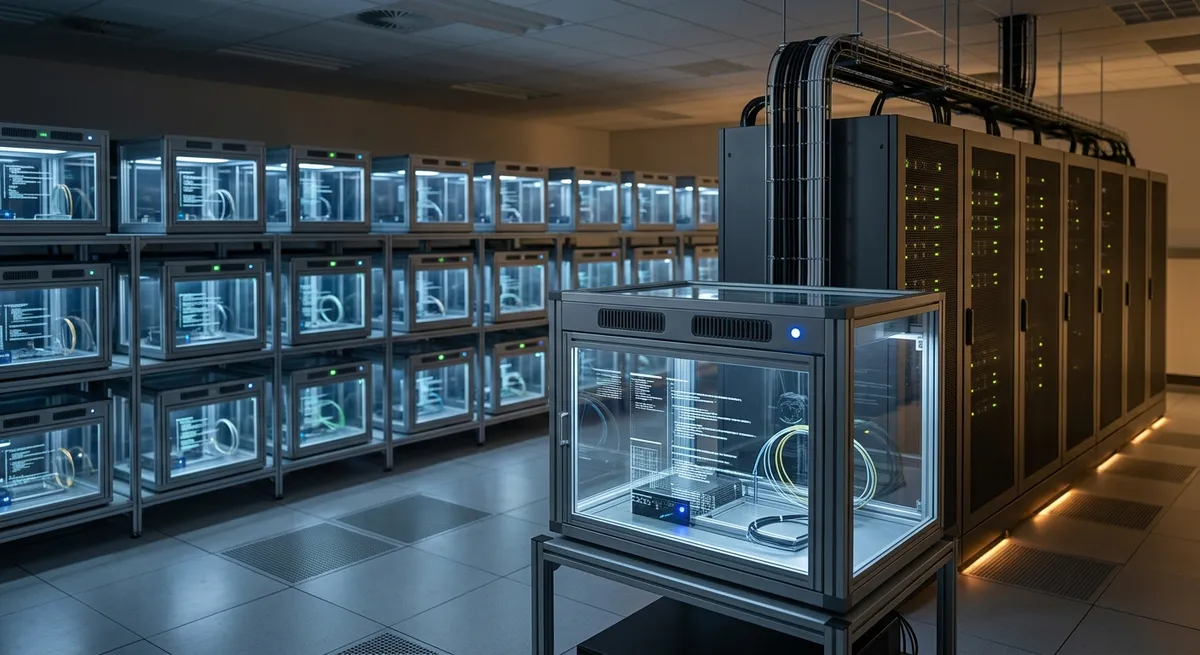
As the race for advanced artificial intelligence accelerates, DeepSeek has introduced DeepSeek Elastic Compute (DSec), a groundbreaking production-scale sandbox platform designed for large-scale agentic LLM training and evaluation. In a world where coding agents are becoming prevalent and capable of tool use and long-running evaluations, the technical infrastructure supporting their training is rapidly gaining importance. This week, the Arxiv paper shedding light on DSec highlights an often-overlooked facet of AI research: the underlying infrastructure that powers the training of these sophisticated agents.
The Need for Sandboxes
Why do AI agents require millions of sandboxes per day? The answer lies in the complexity of their training. As AI labs delve deeper into agentic reinforcement learning, they need environments that can replicate real-world scenarios at scale. With DSec, DeepSeek proposes an elastic execution layer that adeptly coordinates containers, microVMs, full VMs, and more. This setup is crucial for achieving seamless integration between different types of workloads while maintaining rigorous standards of safety and functionality.
Beyond GPUs: The Hidden OS
Traditionally, the AI race focused narrowly on powerful GPUs and model weights, but as the demand for agent training grows, so does the realization that the infrastructure layer behind reinforcement learning must also evolve. DSec stands as the hidden operating system that allows for training AI agents in a secure manner. By isolating the GPU training from the rollout execution, it enables developers to conduct experiments and test model interactions without risking operational failure.
Containers, MicroVMs, and Full VMs
DSec’s architecture sparks an interesting discussion about the best methods for creating safe training environments. The paper posits specific roles for containers, microVMs, and full VMs in agent safety. Containers are lightweight and can be spun up quickly, making them ideal for rapid experimentation. MicroVMs provide a better balance between efficiency and isolation, while full VMs offer the highest degree of separation and security for intensive workloads. The choice between them impacts not only speed and efficiency but also security and reliability in agent training.
Sandboxing: The New Core AI Moat
As the infrastructure supporting AI training becomes more sophisticated, sandboxing is emerging as an essential element that could define competitive advantages in the space. DSec’s proposal does not just address scalability; it also enhances safety by ensuring that agents can interact within controlled environments. This makes DeepSeek’s innovation not only a significant technical leap but also a milestone in establishing a competitive moat – a barrier that makes it difficult for competitors to replicate the success without similar infrastructure investments.
Conclusion
In sum, the launch of DeepSeek Elastic Compute marks a pivotal moment in the AI landscape. By transitioning the focus from mere algorithms and GPUs to the robust infrastructure required for agentic workloads, DeepSeek is redefining what it means to train AI agents effectively. As we look ahead, it’s hard not to wonder how this new infrastructure will shape the next generation of AI technologies, expanding the horizons of what these agents can achieve. If the race for AI supremacy was once about models, it’s becoming clear that the next frontier lies beneath the surface, in the unseen layers of infrastructure like DSec. Buckle up, because this is only the beginning.